

The Automotive Marketing Director's Guide to Attribution: Why Your CRM Data is Lying
Mike Snellenberger , April 14, 2026
Many automotive marketers rely on CRM data to measure performance, but what if that data is misleading? This guide explores the hidden flaws in traditional attribution models, why your CRM may not reflect the true customer journey.
Read our latest blogs
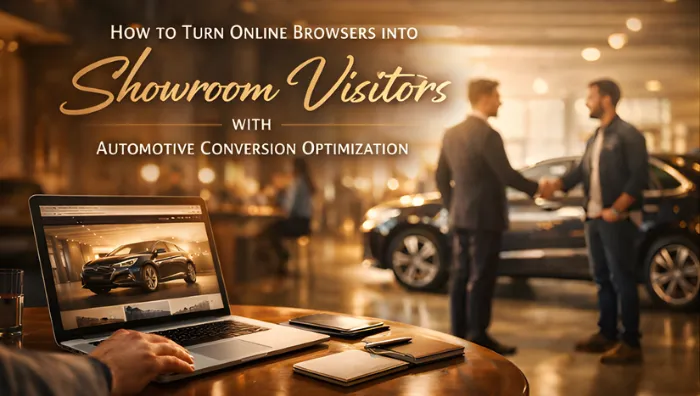
How to Turn Online Browsers into Showroom Vis- itors with Automotive Conversion Optimization
Stop celebrating your website traffic. If you are staring at a Google Analytics dashboard showing thousands of "sessions" while your sales floor sits empty, those numbers are nothing more than a vanity project. Clicks don't pay the floor plan; car sales do.
Most dealerships are trapped in a cycle of "more." More SEO, more PPC, more social media spend. But pouring more water into a leaky bucket doesn't fix the hole. You don't have a traffic problem; you have a conversion problem. You are successfully attracting "online browsers," but you are failing to turn them into "showroom visitors."
Converting a digital lead into a physical appointment requires more than just a functional website. It requires Automotive Conversion Optimization (ACO). But before we talk about the big-picture strategy, let's look at the tactical fires that are likely burning down your ROI right now.
The Tactical Friction: Why Your Browsers Are Leaving
Your website is your 24/7 digital showroom. If a customer walked onto your physical lot and couldn't find a price, couldn't find a salesperson, or was forced to fill out a 12-page background check before seeing a car, they would leave. Yet, that is exactly what most dealership websites do.
1. The VDP Dead-End
The Vehicle Detail Page (VDP) is the most critical conversion point on your site. According to industry data, buyers spend the vast majority of their time here. If your VDPs are cluttered with ten different "Call to Action" (CTA) buttons:Get E-Price, Trade-In Value, Schedule Test Drive, Text Us, Check Availability: you are paralyzing the buyer.
Stop the clutter. Choose one primary action and make it dominant. Use high-quality, original photography: not stock images. Browsers want to see the actual vehicle they are going to drive.
2. Lead Form Fatigue
Look at your lead forms. If you are asking for a home address, middle name, and "how did you hear about us" before the customer can even ask a question, you are killing your conversion rate.
Keep it short:Name, Email, Phone. That's it.
Use dynamic pop-ups:Instead of a static "Contact Us" page, use behavior-triggered pop-ups that offer something of value (like a specific localized offer) when a user has spent more than 60 seconds on a VDP.
3. The Mobile Experience is Non-Negotiable
Most of your customers are browsing while sitting in their driveway or even on a competitor's lot. If your site takes more than three seconds to load or if the "Call" button is buried in a sub-menu, they are gone. Speed is a feature, and in automotive marketing, speed is a conversion tool.
Creating Urgency and Scarcity
Browsers linger because they don't feel a reason to actnow. You need to inject strategic urgency into the digital experience.
Time-Bound Campaigns: Implement 3-7 day promotional windows. Use specific messaging like "Special APR offer ends Saturday at 6 PM" rather than "Best prices in town."
Countdown Timers: Adding a visual countdown to a specific inventory clearance or holiday event creates a psychological "Fear of Missing Out" (FOMO) that drives immediate form submissions.
Inventory Alerts: Use "Low Stock" indicators for popular models. If there are only two units left of a specific trim, tell the browser.
While these tactics will give you a temporary "bump" in leads, they won't fix the underlying issue. This is where the "Trojan Horse" comes in. You can change button colors and shorten forms all day, but if those leads are "trash," your sales floor will still be empty.
The Pivot: Why "Button-Changing" Isn't Enough
Here is the hard truth: You can optimize your website to the moon, but if your marketing strategy is fragmented, you're just making it easier for the wrong people to contact you.
Many dealers hire an SEO company, a separate PPC agency, and a third social media "guru." Each one reports their own version of success. The SEO guy says traffic is up. The PPC guy says clicks are cheap. The Social Media guy says engagement is high. Yet, your dealership marketing is not moving cars.
This is because these vendors are focused on tactics, not outcomes. They are optimizing for their own KPIs, not your bottom line. Conversion optimization is not a standalone task; it is the byproduct of a holistic marketing strategy.
The Fractional CMO Edge: Strategy Over Tactics
This is where a Fractional CMO changes the game. A Fractional CMO doesn't just look at why a button isn't being clicked; they look at why the entire marketing machine is failing to produce a sale.
1. Total Vendor Accountability
A Fractional CMO sits at the head of the table and forces your vendors to speak the same language. We stop the "blame game." If the website isn't converting, we don't just ask the web provider why; we look at the quality of the traffic being sent by the PPC agency. If you are sending high-funnel, low-intent traffic to a high-friction page, no amount of "conversion optimization" will save you.
2. Full-Funnel Attribution
Most dealerships have no idea which dollar actually sold the car. They see a lead come in, but they don't know if that person started on a Facebook ad, read a blog post three weeks ago, and then searched for the dealership on Google. A Fractional CMO implements advanced tracking to understand the benefits of lead generation across the entire journey. We optimize for thesource of the sale, not just the source of the lead.
3. Bridging the Gap Between Marketing and Sales
This is the biggest profit leak in any dealership. Marketing says, "We sent 200 leads." Sales says, "The leads are trash." A strategist looks at the CRM data. Are the leads being followed up within five minutes? Are the email automations personalized based on browsing behavior? If you are using generic email blasts, you are wasting the hard-earned traffic you just paid for. We align the CMO services with your BDC's actual workflow.
How to Improve Your Dealership Website Conversions Permanently
If you want to move the needle, you have to stop thinking about your website as a digital brochure and start thinking about it as a lead-generation engine that requires expert oversight.
Audit the Friction: Go to your own website on your phone. Try to find a car and schedule a test drive. If it takes more than four clicks, you're losing money.
Focus on High-Intent Pages: Apply the PIE framework (Potential, Importance, Ease). Fix your VDPs first. That is where the money is.
Implement Behavior-Triggered Automation: Use platforms to deliver personalized messages. If a user looks at three different trucks, your next email to them should be about trucks, not a general "service special" blast.
Hire Strategy, Not Just Labor: You don't need another person to "post on Facebook." You need a Fractional CMO to fix your dealership's marketing.
The Bottom Line
Conversion optimization is the bridge between an "online browser" and a "showroom visitor." Tactical fixes like better forms and faster load times are the foundation, but they cannot stand alone. Without a high-level strategy to align your traffic sources, your messaging, and your sales follow-up, you are simply spending more money to fail faster.
Stop letting your marketing budget disappear into a black hole of "clicks" and "impressions." It's time to demand a strategy that actually moves the needle on your monthly unit count.
Ready to see how a strategic overhaul can transform your dealership? Learn how to improve dealer-ship website conversions or reach out to The Fractional CMO Team today to stop the leak and start selling.
Contact us here to schedule your strategy audit

MENU
Contact
© Copyright 2026. The Fractional CMO Team. All rights reserved. Privacy Policy
Facebook
Instagram
X
LinkedIn
Youtube